

Records Management Inflection Point
In the early years of a records management program, most organizations experience a stable and predictable environment.
Records are securely stored, retrieval requests are fulfilled, and billing structures—especially flat-rate or bundled models—provide operational simplicity.
For this reason, organizations rarely reevaluate their records management model immediately.
However, over time a pattern emerges. Storage inventories grow, inactive records accumulate, and leadership begins to examine the long-term financial and compliance implications of the program.
For many organizations, this moment occurs around Year 3.
This moment is commonly referred to as the 3-Year Records Management Inflection Point.
It is the point at which the structural strengths and weaknesses of a records management model become visible.
Why the First Two Years Rarely Reveal the Full Picture
During the first one to two years of a records management program, most operational signals appear positive.
Organizations typically experience:
predictable monthly billing
simple retrieval workflows
minimal administrative oversight
stable storage volumes
Because records accumulate gradually, inefficiencies rarely appear immediately.
At this stage, the program is evaluated primarily on service performance rather than long-term governance outcomes.
This early stability explains why many organizations initially feel confident in their records management structure.
What Changes Around Year Three
Around the three-year mark, several structural patterns begin to emerge.
Storage programs that once appeared stable now reveal deeper dynamics.
Organizations begin noticing that:
storage inventories have grown materially
inactive and legacy records now represent the majority of stored materials
retention schedules were rarely applied to older inventories
storage costs remain stable—but do not decline
leadership begins asking questions about total cost of ownership
At this stage, the organization is no longer evaluating operational service quality alone.
Instead, it begins evaluating whether the records management program is actively improving outcomes over time.
The Financial Dimension of the Inflection Point
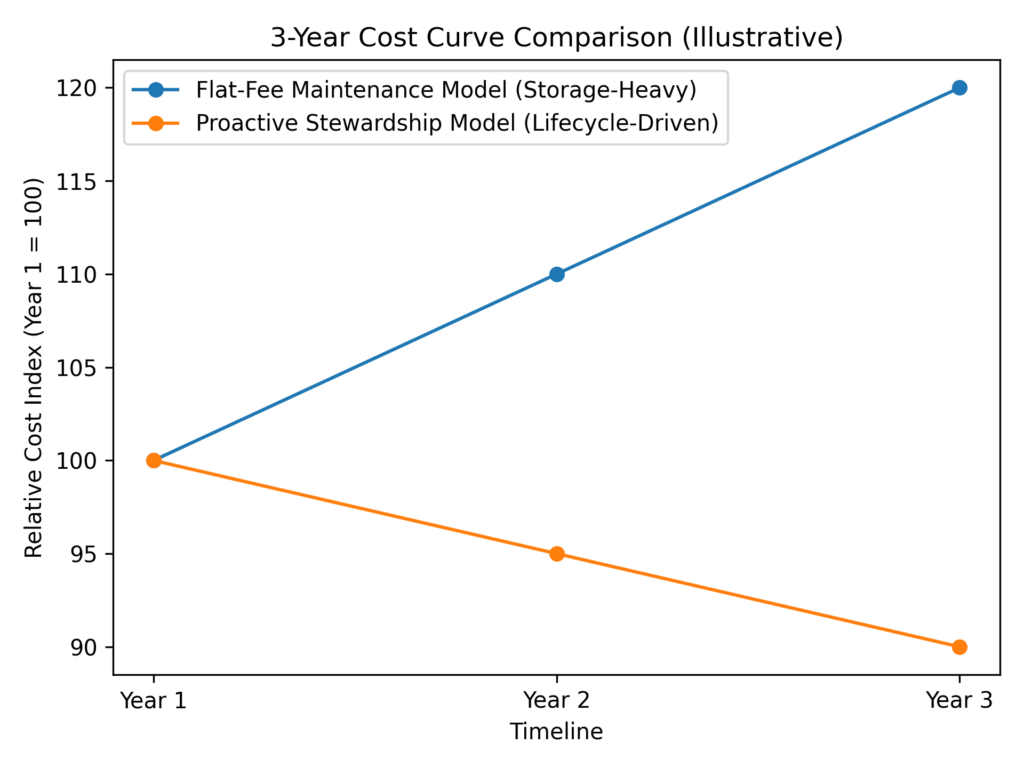
In storage-heavy environments, the financial implications of records governance begin to surface around this stage.
Many organizations discover that bundled or flat-rate storage models can produce structurally higher storage costs over time, particularly when inactive records accumulate without lifecycle review.
This occurs because:
legacy inventories grow faster than they are reduced
unused bundled services may offset the visible cost of storage
retention decisions are deferred
storage footprints expand without active optimization
In some cases, organizations operating under storage-heavy bundled models observe effective storage costs roughly 25–30% higher than lifecycle-optimized environments over several years.
This difference rarely appears immediately.
It becomes visible once storage volume and retention ambiguity compound.
The Risk Dimension
The 3-year inflection point is not only financial.
It is also operational and compliance-related.
By this stage, many organizations discover that:
legacy record ownership is unclear
retention schedules were inconsistently applied
disposition documentation may be incomplete
historical records remain stored without clear justification
These conditions can create challenges during:
regulatory audits
litigation discovery
internal compliance reviews
organizational restructuring or mergers
The longer legacy records remain unmanaged, the more difficult it becomes to resolve these issues efficiently.
Maintenance vs Stewardship: The Structural Difference
At the inflection point, organizations begin recognizing a fundamental difference between two records management philosophies.
Maintenance Model
A maintenance model focuses primarily on operational reliability:
secure storage
efficient retrieval
predictable billing
minimal disruption
This model supports continuity but does not actively reduce legacy inventory or storage exposure.
Stewardship Model
A stewardship model expands the objective of records management beyond storage.
It introduces lifecycle governance practices such as:
reviewing inactive record inventories
aligning records with defensible retention policies
documenting disposition decisions
gradually reducing unnecessary stored volume
strengthening audit readiness
The goal is not only to maintain storage but to ensure the records program improves over time.
Why Many Organizations Reevaluate Their Model at This Stage
Organizations rarely reconsider their records management partner because service quality declined.
Instead, the trigger is often strategic.
Leadership begins asking questions such as:
Are we actively reducing unnecessary storage?
Do we have visibility into legacy record risk?
Is our program aligned with defensible retention practices?
Are we optimizing total cost of ownership?
When these questions arise, organizations frequently explore whether a more proactive records management approach could provide additional long-term value.
What a Proactive Records Strategy Looks Like
Organizations that adopt a lifecycle-driven records management model typically implement several key practices.
These include:
periodic review of legacy inventories
structured retention alignment
documented, defensible disposition decisions
clear ownership of stored records
continuous improvement of storage efficiency
Over time, these practices create measurable improvements in both cost management and compliance posture.
Rather than maintaining a static storage program, the organization develops a records governance model that evolves alongside its operational needs.
Why the Inflection Point Matters
The 3-Year Records Management Inflection Point is important because it represents the moment when organizations transition from operational evaluation to strategic evaluation.
In the early years, the primary question is: Is the service reliable?
Around Year 3, the question becomes: Is the program improving outcomes?
Organizations that recognize this moment early are often able to reduce long-term storage exposure, strengthen compliance governance, and improve total cost efficiency.
If your organization has maintained a storage program for several years and is beginning to evaluate cost, risk, and legacy record exposure, it may be helpful to conduct a structured review.
VeriTrust partners with Texas organizations to assess existing records programs and identify opportunities for lifecycle improvement and long-term cost reduction.
Schedule a 15-minute evaluation with a VeriTrust specialist.