

Here’s What Texas Organizations Evaluate as Their Needs Mature
Many organizations search their current records and media management provider not because service failed—but because something changed. Compliance expectations rise, legacy records accumulate, and leadership begins asking whether today’s model is still producing the right long-term outcomes.
If you’re using Safesite (safesite.cc) and exploring alternatives in Texas, this page is designed to help you evaluate the decision with a clear lens: total cost of ownership (TCO), audit defensibility, and long-term risk exposure—especially for non-active and legacy records.

Both are Texas-based. The difference is the time horizon.
Safesite and VeriTrust share key fundamentals:
- Texas-based, regional service coverage (Houston, Austin, San Antonio, Corpus Christi, Dallas)
- Privately held
- Service-oriented culture
- Experience across healthcare, legal, financial, and regulated industries
VeriTrust also brings:
- 20+ years partnering with Texas organizations
- Experience supporting complex, regulated environments (including Fortune 100 ecosystems)
- Owner-engaged management
- A model designed for operational simplicity + ongoing optimization, not “set it and forget it”
The difference isn’t whether service is reliable.
The difference is whether your RIM model is designed to improve outcomes over time.
Why organizations using Safesite begin evaluating alternatives
Most organizations do not compare vendors casually. The most common triggers are maturity-related:
- Inactive and legacy records keep growing
- Storage costs stay predictable—but don’t decline
- Audit scrutiny increases (documentation expectations rise)
- Leadership wants clearer risk visibility (not assumptions)
- “All-inclusive” feels simple, but less transparent as record volumes grow
This shift is usually about evolution, not dissatisfaction.
Flat-rate billing is simple. But simplicity can become subsidized.
Flat-rate, all-inclusive pricing removes friction. In the early years, it can be a strong fit—especially for teams who value predictability.
However, in storage-heavy environments, a common structural tradeoff emerges:
High storage costs are often subsidized by bundled services a client may not actively use.
Over time, this creates a quiet imbalance:
- Storage-heavy clients carry a higher “embedded” cost base
- Included services go unused, yet still shape pricing
- Legacy inventories often remain unchallenged
- “Covered” costs reduce urgency to reduce the storage footprint
This is not a service failure.
It’s a cost-allocation reality that becomes visible with time.
The 3-Year Records Management Inflection Point
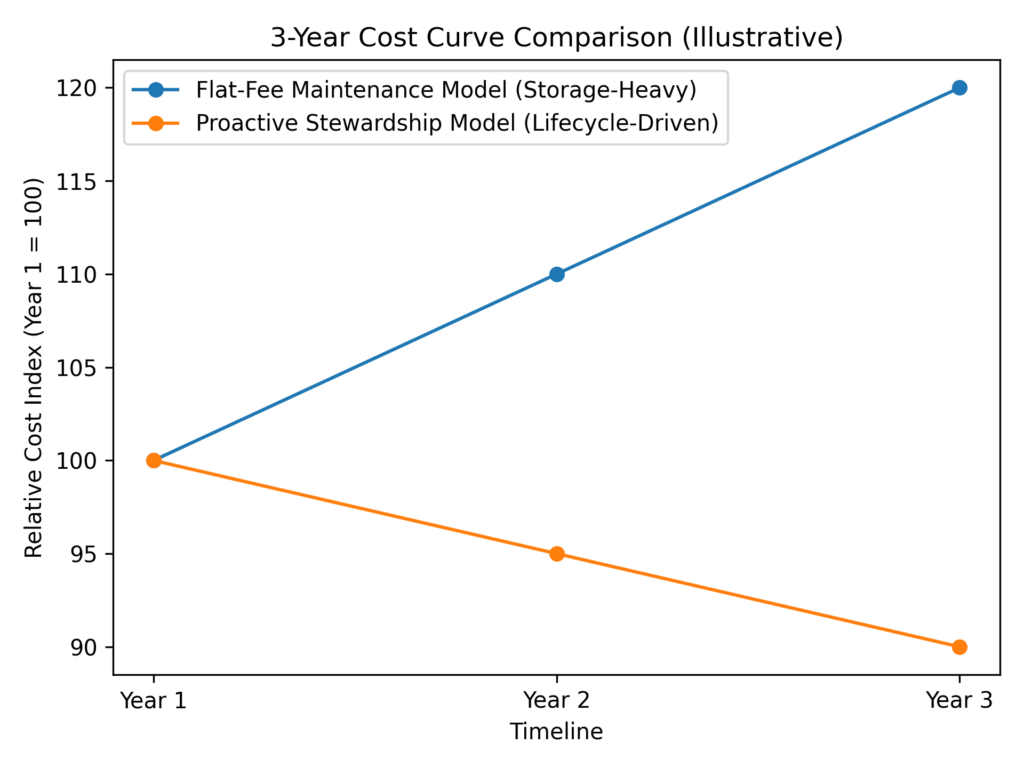
For many organizations, the true cost and risk difference between flat-rate maintenance and proactive stewardship becomes measurable around Year 3.
Why Year 3 is often the visibility point:
- Storage volumes grow faster than they are reduced
- Legacy records remain untouched
- Retention decisions are deferred rather than documented
- Audit defensibility depends on assumptions vs governance
- TCO becomes clearer as volume compounds
In many storage-heavy scenarios, leadership later discovers the effective storage burden under bundled flat-fee models can be ~30% higher over time compared to lifecycle-optimized approaches—particularly when inactive/legacy records are not actively reduced.
At this point, the executive realization is common:
“We achieved predictable billing, but not measurable reduction in cost or exposure.”
Flat-Fee Maintenance Model (storage-heavy)
Year 1: 100 → Year 2: 110 → Year 3: 120
Proactive Stewardship Model (VeriTrust approach)
Year 1: 100 → Year 2: 95 → Year 3: 90
This is why many organizations don’t feel urgency early—then feel it clearly by Year 3.
Results vary by retention requirements, record mix, and legacy volume. The pattern is consistent: proactive lifecycle governance creates downward pressure on storage volume and long-term exposure.)
Non-active and legacy records are where cost and risk live
In most organizations, the highest concentration of unnecessary spend and compliance exposure comes from:
- Boxes not accessed for years
- “Just in case” retention habits
- Media tied to older systems/vendors
- Unclear ownership of retention decisions
- Lack of documented, defensible disposition
When non-active records remain unmanaged, both cost and risk compound:
- Larger discovery sets in litigation
- Longer liability duration
- Higher audit burden
- More difficult transitions during M&A or restructuring
VeriTrust’s model is designed to bring clarity and governance to this exact problem.
What proactive partnership looks like with VeriTrust
VeriTrust combines operational simplicity with active stewardship:
- Lifecycle review for non-active and legacy inventories
- Retention alignment and defensible disposition planning
- Measurable reduction in unnecessary stored volume
- Audit-ready documentation discipline
- A partnership posture designed to stay proactive—not complacent
The goal isn’t complexity.
The goal is simplicity that improves year over year.
Is switching from Safesite hard?
For most organizations, no.
VeriTrust transitions clients from long-standing regional providers through a structured, low-disruption process that includes:
- Inventory reconciliation
- Chain-of-custody continuity
- Retention alignment
- Phased onboarding
- Stakeholder communication and a defined cutover plan
Most clients describe the transition as:
“Easier—and calmer—than expected.”
- Have substantial inactive / legacy records
- Want predictable operations and improved outcomes over time
- Need stronger audit defensibility
- Suspect you’re paying an embedded premium for storage-heavy realities
- Want an owner-engaged, Texas-based partner aligned to long-term performance

If you’re using Safesite and want to evaluate your long-term cost and compliance exposure (especially with inactive and legacy records), request a review.
FAQ
Usually not because service failed—because compliance expectations, legacy volume, and TCO visibility evolve over time.
Flat-rate can be effective early. In storage-heavy environments, the embedded cost base can become higher over time when storage is subsidized by unused bundled services.
The point at which accumulated volume and deferred lifecycle decisions make cost and risk differences measurable.
Typically not. VeriTrust manages reconciliation, chain-of-custody, and phased onboarding to minimize disruption.